/webcode.jsp
/en/search/index.jsp
The AMCAW database of analytical methods for chemical agents at workplaces contains suitable validated methods for measuring hazardous substances in workplace atmospheres. Substances of importance owing to their relevance to occupational safety and health are listed, and the associated methods are evaluated against European standards for their suitability and quality. The criteria for selection of a substance include the number of analyses available for it, the existence of an EU limit and the relevance of the substance to occupational safety and health.
The AMCAW provides a quick and user-friendly overview of methods used by various occupational safety and health institutions to measure hazardous substances at the workplace.
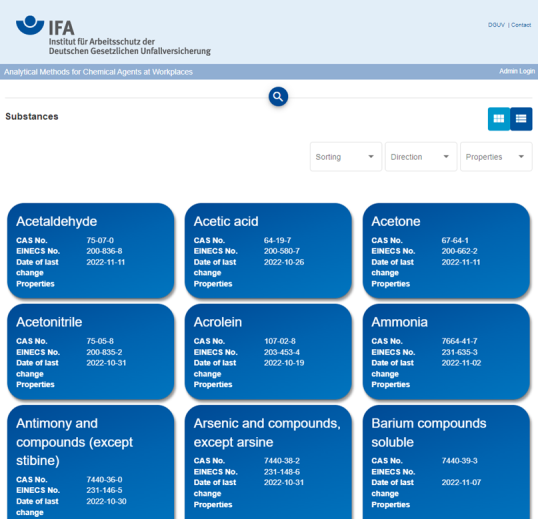
A substance can be searched either by its CAS number or by its name. After selecting a substance, a table is displayed containing the key information on the respective analytical method, including the language version, year of publication, and analytical technique applied (e.g. HPLC-DAD or GC-FID).
An integrated drop-down menu presents the central methodological performance characteristics in a clear and concise format. These include the method principle, sampling conditions, sample preparation, the analytical determination method, limit of detection (LOD), limit of quantification (LOQ), the working range of the method, and the associated expanded measurement uncertainties.
In addition, each measurement method undergoes a systematic evaluation. Methods ranked “A” comply with the general requirements of EN 482 as well as the specific requirements of CEN/TR 17055 and/or those of the EN 13205 series. If a method does not meet the requirements of DIN EN 482 and does not have the potential to achieve compliance, it is assigned a “C” ranking. The “B” ranking and a more detailed explanation of the classification are provided under Indicative evaluation of the measurement methods.
For further information on the selected method, links to the original sources are provided.
The project was funded primarily by the European Commission and the European Free Trade Association (EFTA). DIN (Deutsches Institut für Normung) supported organization of the project in its capacity as the secretariat of CEN TC 137.
The database was created in cooperation with experts from ten European institutes:
The database was comprehensively revised and updated by the IFA in 2023. It is now based on a modern database platform, and as a result has been made significantly more user-friendly. Data on 151 substances have been recorded to date. The number of hazardous substances available for reference is set to grow continuously in the coming years.
Please refer to the general terms and conditions of use of GESTIS-AMCAW for details on usage and liability.
For information on the processing of your personal data, please consult the GESTIS-AMCAW Privacy Notice.
The application is browser-independent; it has been tested with Chrome (Version 102.0 and later) and Firefox (Version 101.0 and later).
Use of a desktop browser is recommended for the current version. Display problems may arise on mobile devices.
Support in resolving access problems
Information on the accessibility status of the GESTIS-AMCAW database is provided in the accessibility declaration.