/webcode.jsp
/en/search/index.jsp
| The PT scheme inorganic acids will not be offered in 2026, but it will prospectively be offered again in 2027. Are you interested in this proficiency test? If so, please send us a short e-mail. |
The proficiency testing (PT) is offered optionally with and without own sampling. Participants may choose whether they wish to perform sampling for inorganic acids themselves, or to have the sample carriers supplied to them [1]. The concentrations to be measured for volatile and non-volatile inorganic acids will lie within the range between 1/10 and twice the AGW1 value [2]. Since there is only a short-time limit value for nitric acid, the concentration of one test gas is in accordance with this limit value. The concentrations of the other two test gases are in accordance with the limit value of hydrochloric acid. For HCl and HNO3, the IFA recommends the analysis method for hazardous substances described in IFA Folder No. 6172 [3], DFG [4] or NIOSH [5]. For H2SO4 and H3PO4, a procedure according to IFA Folder 6173 [6], DFG [7] method or NIOSH [8] is recommended. (Please note: IFA Folder (IFA Arbeitsmappe) is available in German only.)
Ion chromatography should be employed for analysis.
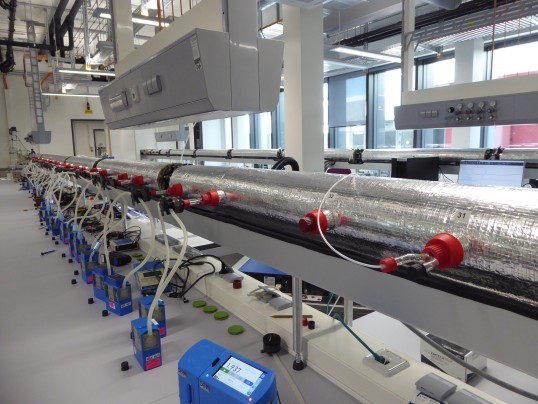
A large-scale dynamic test gas stream can be found at the IFA. It is suitable for parallel sampling by up to 25 participants.
The registration for the PT schemes with own sampling is valid for only one person per participating company or institution. If you would like to participate with more than one person, please contact us in advance.
In good time, participants will receive detailed information on the PT scheme, a description of the apparatus, and the connections for the sampling devices in particular.
In addition, the participants will receive the sample kit for H2SO4 and H3PO4 (see 2.2 below).
The PT for inorganic acids consists of two parts [1]: The same filters are used for volatile and non-volatile acids:
Loading of the sample carriers for volatile inorganic acids is performed at the dynamic test gas stream of the IFA. Alkaline impregnated* quartz fibre filters are employed as sample carriers.
* Impregnating solution: 1.0 mol/L sodium carbonate solution
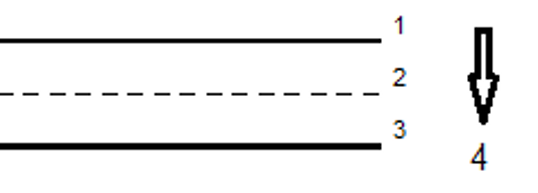
Structure of the filter combination in the filter cassette
1: Pre-filter: salts of the acids are trapped on the pre-filter.
2: Spacer: to separate the filter
3: Sampling filter: alkali-impregnated quartz fiber filter. Please analyse this filter!
4: Direction of air flow through the sampler
Quartz-fibre filters are loaded with sulphuric acid and phosphoric acid. The loaded filters are stabilised with 4 mL desorption solution (c (Na2CO3) = 3.1 mmol/L and c (NaHCO3) = 0.35 mmol/L) [1].
Each participant receives two sampling kits comprising of:
1 The German acronym AGW stands for Arbeitsplatzgrenzwert (Occupational Exposure Limit value - OEL). For carcinogenic substances and substances without AGW the database GESTIS - International limit values for chemical agents (www.dguv.de/ifa/gestis-limit-values) is used.
[1] Ringversuch Anorganische Säuren (Kennzahl 1630-2) In: IFA-Arbeitsmappe Messung von Gefahrstoffen. Lieferung: 01/2022
[2] GESTIS – Internationale Grenzwerte für chemische Substanzen
[3] Anorganische Säuren, flüchtig: Bromwasserstoff, Chlorwasserstoff, Salpetersäure (Kennzahl 6172). In: IFA-Arbeitsmappe Messung von Gefahrstoffen. Lieferung: 02/2023
[4] Deutsche Forschungsgemeinschaft (DFG). Volatile inorganic acids (HCl, HBr, HNO3). In: Analyses of hazardous substances in air. Volume 6. Hrsg.: Kettrup, A. Wiley-VCH, Weinheim 2002
[5] Volatile Acids by Ion Chromatography (HCl, HBr, HNO3). Method 7907. In: NIOSH, Manual of Analytical Methods, Fifth Edition, Issue 1, 20 May 2014
[6] Anorganische Säuren, partikulär: Phosphorsäure, Schwefelsäure (Kennzahl 6173) In: IFA-Arbeitsmappe Messung von Gefahrstoffen. Lieferung: 01/2016
[7] Deutsche Forschungsgemeinschaft (DFG). Inorganic acid mists (H2SO4, H3PO4). In: Analyses of hazardous substances in air. Vol. 6. Hrsg.: A. Kettrup. Wiley-VCH, Weinheim 2002
[8] Non-Volatile Acids (H2SO4, H3PO4). Method 7908. In: NIOSH, Manual of Analytical Methods, Fifth Edition, Issue 1, 20 May 2014