/webcode.jsp
/en/search/index.jsp
| The PT scheme metals will not be offered in 2026 due to declining participant numbers. However, it will prospectively be offered again in 2027. Do you have any suggestions for improving this PT scheme? If so, please send us a brief email. Feedback from our customers is particularly helpful in further developing our PT schemes. |
Filter samples bearing metal particles will be shipped. Sampling is performed by means of the total dust sampling system (GSP) on cellulose-nitrate filters (pore size: 8 µm; diameter: 37 mm) [1].
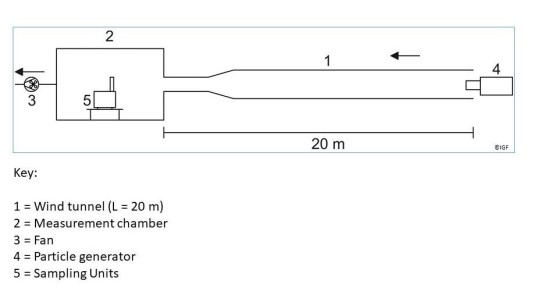
These samples are produced at the Institute for the Research of Hazardous Substances (IGF) of the German Social Accident Insurance Institution for the raw materials and chemical industry (BG RCI) in Dortmund. Aqueous metal salt solutions are pyrolysed by means of a flame generator. The resulting metal oxide particles are passed at a defined air flow rate through a steel tube (wind tunnel) with a length of 20 m and a diameter of 0.5 m (see figure). This tube opens into a measurement chamber with a volume of approximately 20 m³ in which the sampling units are located. Homogeneous distribution of the particles is assured at all points within the measurement chamber [2].
The concentrations will lie within a range of 0.1 to 2 times of the risk-based assessment criteria of the respirable fraction. In consideration of the analytic performance of the analysis methods to be employed, deviating concentration ranges are expected to be selected for cobalt, nickel, chromium and indium. These will be made known in good time. The risk-based assessment criteria listed in the following table are used as a basis for selecting concentrations; as a rule, reference is made to the lowest published values.
| Metal | Risk-based assessment criteria in mg/m3 | Remark |
| Zn and its inorganic compounds | 0.1 [6] | DFG (Respirable fraction) |
| Cu and its compounds | 0.045; 0.01 [6] | AGS, DFG (Respirable fraction) |
| Pb and its inorganic compounds | 0.15; 0.004 [6] | AGS, DFG (Inhalable fraction) |
| Ni, carc. 1A and 1B | 0.006 [6] | AGS (Respirable fraction) |
| Co and its compounds, carc. 1A and 1B | 0.0005 [6] | AGS (Respirable fraction) |
| In | 0.0001 [6] | AGS (Respirable fraction) |
| Mn and its inorganic compounds | 0.02 [6] | AGS (Respirable fraction) |
| Cr | 0.012* [6] | AGS (Respirable fraction) |
| *following the limit value of chromium sulfate | ||
With the help of an additional particle generator, it is possible to load the filters also with iron as interference matrix.
Each participant will receive a sample kit comprising:
The analysis method (AAS methods, ICP) may be selected freely. The recommended digestion method is that published by the DFG (the German Research Foundation) [3] and the IFA folder No. 6015 [4] for the digestion of metal dusts.
In this IFA folder an open digestion and a microwave digestion can be used. In a comparative study it could be shown that both digestion methods can be used equivalently [5]. Short descriptions of the two digestion methods are sent to the participants together with the samples.
1 The German acronym AGW stands for Arbeitsplatzgrenzwert (Occupational Exposure Limit value - OEL). For carcinogenic substances and substances without AGW the database GESTIS - International limit values for chemical agents (www.dguv.de/ifa/gestis-limit-values) is used.


Department Chemical and Biological Hazards
Krista Gusbeth
Franziska Nürnberger
Ronja Schneck
Max Vonolfen
Phone: +49 30 13001-3299
[1] Ringversuch Metalle auf Filtern (Kennzahl 1630-4) In: IFA-Arbeitsmappe Messung von Gefahrstoffen. Lieferung 01/2022
[2] Monsé, C. et al.: Development and Evaluation of a Nanoparticle Generator for Human Inhalation Studies with Airborne Zinc Oxide. Aerosol Sci. Technol. 48 (2014) Nr. 4, S. 418-426
[3] Aufarbeitungsverfahren für Stäube zur Bestimmung des "Gesamtmetallgehaltes". In: DFG, Analytische Methoden zur Prüfung gesundheitsschädlicher Arbeitsstoffe, Luftanalysen. Band 1: Spezielle Vorbemerkungen, Abschnitt 4 "Probenahme und Bestimmung von Aerosolen und deren Inhaltsstoffen". 14. Lfg. Verlag Chemie, Weinheim 2005, S. 31-32
[4] Aufarbeitungsverfahren zur Analytik metallhaltiger Stäube, Methodik zur Bestimmung des "Gesamtmetallgehaltes" (Kennzahl 6015) In: IFA-Arbeitsmappe Messung von Gefahrstoffen. Lieferung 02/2018
[5] Pitzke, K.; Gusbeth, K.; Hebisch, R.; Kirchner, M.; Schuh, C.; Schwank, T.; Sonnenburg, R.; Timm, K.; Breuer, D., Projektstudie: Vergleich von Aufschlussverfahren für die Bestimmung des Gesamtmetallgehaltes in Staubproben (PDF, 406 kB, non-accessible) Teil 2: Ringversuch Teil 1, DFG-Arbeitsgruppe "Luftanalysen", Gefahrstoffe - Reinhaltung der Luft 78 (2018) Nr. 4, S. 138-151.