/webcode.jsp
/en/search/index.jsp
The new PT scheme "Diisocyanates on filters" serves as a quality assurance measure for the analyses of diisocyanates relevant to occupational health and safety.
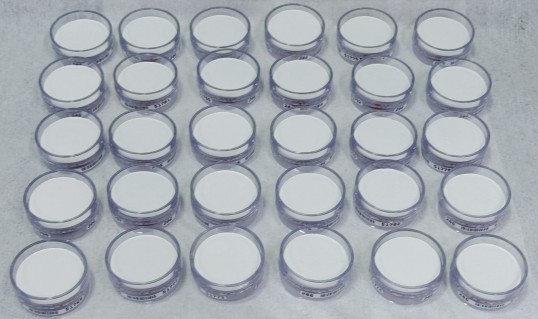
Since it is not possible to evaporate diisocyanates in the test gas stream, air samples are simulated by spiking filters with diisocyanates. The spiking process is performed using an electronic pipette. After spiking and drying, the spiked and dried filters are sent to the participants.
An initial comparative measurement was conducted in 2024. Based on the promising results, a test PT scheme is now offered for the first time.
The filters will be spiked with the following substances:
| Diisocyanate | CAS Number |
| Diphenylmethane 4,4‘-diisocyanate (4,4‘-MDI) | 101-68-8 |
| Hexamethylene 1,6-diisocyanate (HDI) | 822-06-0 |
| Isophorone diisocyanate (IPDI) (isomeric mixtures) | 4098-71-9 |
| Naphthylene 1,5-diisocyanate (NDI) | 3173-72-6 |
| Toluene 2,4-diisocyanate (2,4-TDI) | 584-84-9 |
| Toluene 2,6-diisocyanate (2,6-TDI) | 91-08-7 |
The concentrations for each individual diisocyanate will range from approximately 1.5 to 24 µg per filter. In total this PT scheme will consist of four samples, three for all analytes except NDI and one additional sample only spiked with NDI.
Each participant will receive a sample kit with ten filters (one type) comprising of:
Analysis according to the IFA-Folder 7670 [1] is recommended. The corresponding international methods [2, 3] may also apply.
[1] Isocyanate – Monomere Diisocyanate, Totalkonzentration reaktiver Isocyanatgruppen (TRIG) und Polyisocyanatgehalt (Kennzahl 7670) In: IFA-Arbeitsmappe Messung von Gefahrstoffen. Lieferung: 01/2020.
[3] ISO 16702: Workplace air quality – Determination of total organic isocyanate groups in air using 1-(2-methoxyphenyl)piperazine and liquid chromatography. Geneva 2007.


Department Chemical and Biological Hazards
Krista Gusbeth
Franziska Nürnberger
Ronja Schneck
Max Vonolfen
Phone: +49 30 13001-3299