/webcode.jsp
/en/search/index.jsp
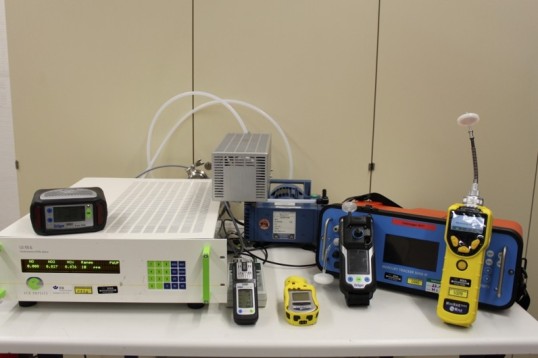
Direct-reading measuring Instruments (DAZ, Direktanzeigende Messgeräte) are becoming more popular for the measurement of hazardous substances at workplaces [1]. Besides the quantification directly on-site DAZ are used for the determination of the concentration of hazardous substances for which no sampling methods exist. Additionally, they are a practical method for monitoring peak concentrations and short-time exposure limits [2] in accordance with the Technical Rules for Hazardous Substances (TRGS, Technische Regeln für Gefahrstoffe) 900 [3], 910 [4] and 402 [5].
For substances which can be sampled the individual steps from sampling to analysis are validated on a regular basis and are subject to quality assurance measures. In contrast only few direct-reading measuring instruments are tested especially for workplace measurements and are certified as such. Most instruments are utilized as gas detectors. Carrying out PT schemes for direct-reading measuring instruments offers the participants a possibility to assess their instruments. Additionally, it is the first step for improving the quality and certification of direct-reading measuring instruments for the detection of hazardous substances at the workplace.
For this reason, the IFA will offer a test PT scheme for direct-reading measuring instruments at the test gas stream in 2026. Ideally, 15 participants from accident insurance providers and industry should take part to ensure sufficient space for all devices on the test gas stream and to obtain enough data for statistical evaluation. Therefore, the maximum number of participants is initially limited to 15. Depending on demand, additional places may be made available.
Participants are ideally expected to use instruments which comply with the requirements of the standard DIN EN IEC 62990-1 [6].
The details of this PT scheme are still being finalised and will be communicated as soon as possible. If you have any direct questions please contact: proficiency-testing@dguv.de.
Requirement for the participation:
[1] Direktanzeigende Messgeräte: Anspruch und Wirklichkeit – ein Diskussionspapier. In: Gefahrstoffe 80 (2020) Nr. 10, 385-389.
[2] Beurteilung von Konzentrationsspitzen am Arbeitsplatz – eine Arbeitshilfe. In: Gefahrstoffe 83 (2023) Nr. 07-08, 131-142.
[3] TRGS 900: Arbeitsplatzgrenzwerte (06.05.2025).
[4] TRGS 910: Risikobezogenes Maßnahmenkonzept für Tätigkeiten mit krebserzeugenden Gefahrstoffen (20.03.2025).
[5] TRGS 402: Ermitteln und Beurteilen der Gefährdungen bei Tätigkeiten mit Gefahrstoffen: Inhalative Exposition (11.09.2023).
[6] DIN EN IEC 62990-1:2023-12 Workplace atmospheres - Part 1: Gas detectors - Performance requirements of detectors for toxic gases (IEC 62990-1:2019, modified + COR1:2019); German version EN IEC 62990-1:2022 + A11:2022.


Department Chemical and Biological Hazards
Krista Gusbeth
Franziska Nürnberger
Ronja Schneck
Max Vonolfen
Phone: +49 30 13001-3299